20.01.2026
Designing Sets and Lighting for Ballet: In conversation with Jon Buswell
In preparation for the world premiere of Alice Topp's explosive new adaptation of Macbeth, we spoke to award-winning designer Jon Buswell about his introduction to set and lighting design, how he begins the process of designing for ballet, and his approach to this bold new production.

How did you first get interested in set and lighting design?
My Art teacher at school was an amateur designer at our local theatre. He could see that I was interested in larger scale works so offered me the opportunity to work on a couple of shows that he was designing. So I painted sets and helped put them up. At the local theatre I was also introduced to lighting, so I did that for a while. It was just a hobby back then but I’d obviously got the theatre bug.
Was there a particular moment or production that inspired you to pursue this career?
Not as such. I didn’t know what to do after graduating school, so I got a job in retail, which led quite quickly to a position as copywriter in the advertising department of that company. By this point I hadn’t worked in the local theatre for a couple of years. The advertising job was going to be relocated to Europe, so I was at a crossroads. I decided to go to Art school to study design as it had become clear to me that I was not enjoying advertising – mainly because I was hopeless at it.
Did you study design formally, or were you largely self-taught?
I attended the Croydon School of Art, studying Theatre Studies (design). It was a three year sandwich course but half of year two was to be spent on secondment. The thing about art school or any college setting is that you obtain certain skills but they are all fairly meaningless until you get out there in to the industry.

Logos by Alice Topp, as part of Lightscapes by the Royal New Zealand Ballet, 2023. Photo credit: Stephen A’Court.
How has your approach to design evolved over the years?
I specialised in lighting design mainly over the last 30 years or so. Set design has come to me fairly late in the game (although that is what I originally went to school to study). So I have (I hope) been a collaborative and supportive lighting designer to the set and costume designers I have worked with. I think as you gain more experience, you tend to have a sixth sense of what to do for a design brief, so you are not always starting from first principles.
Are there productions you’ve worked on that were turning points in your career?
For sure. It was 2001 and the show was Tantalus for the Royal Shakespeare Company (where I used to work as a lighting technician in the early days). The show had been conceived and built with the Denver Center for Performing Arts. It had been in production rehearsals for six months (this was a play that was 10 hours long, covering the ten years before, the ten years of and the ten years after the Trojan war). I got the call to handle the relight out of Denver back in to the UK except that the tour had to get in and open in three days in each venue it toured to. I worked very hard with the production managers and other associates to deliver the show. The director was Sir Peter Hall. When he caught up with the production in London, he offered me a lighting design job in the West End of London. That was a major turning point for me.
What was your initial reaction to the choreography and concept of this new production of Macbeth?
Well, Alice and I developed the concept very much together. We knew we wanted a modern adaptation and watched a number of films and videos of shows where that had been done. Once the team was formed the rough shape that we had got together was moulded and teased in to what you will see tonight. The main thing was that Macbeth 400 ish years ago was a shocking play, so even though lots of people know the story, we still wanted it to be a surprise.
How do you begin your design process when working on a ballet?
Always by talking through concepts with the choreographer. Alice and I have come up with concepts in all sorts of places, (one was across the aisle of a plane flight). I do a very bad sketch of something and we let that sit for a while, we meet up again and maybe develop that further or pivot to something else.
How do you know when a design idea is ‘right’?
I think when you’ve been through the synopsis of the show, all the scenes and the choreographer has had a chance to think through the movement, you’ve listened to the music, and the costumes are drafted, only then are you truly able to commit to it. It’s quite risky to present a design 12-18 months before rehearsals start (as it usually the case with opera and ballet) because you are locking in the visuals before the choreographer has developed the language with the dancers.

To Hold by Sarah Foster-Sproull, as part of Solace, 2024. Photo credit Stephen A’Court.
Do you have a personal signature style, or do you adapt completely for each production?
My personal style is basically limited by my inability to paint properly. So I tend to design things that have structure and texture rather than scenic art as such. I also like things to be able to move or somehow reshape the spaces inhabited by the dancers. I’d love to be able to design painted scenery as I think it has an important role to play in the future of design for the stage, however I won’t be the one doing it.
Do you draw inspiration from other visual art forms (film, theatre, paintings) for your designs? If so, what have been the key visual influences for Macbeth?
I tend to look at paintings for inspiration. I have a good art encyclopaedia which is a good source to flick through to get a sense of mood etc. What I don’t do (and can’t do) is look at Pinterest boards or anything like that. I find this puts too many images in my head and makes me think only in those visual terms. Trying to find a medium that is unrelated helps me to gather thoughts more easily.
When imagining the set and lighting together, do you start with one first, or do they develop simultaneously?
For me, I start the set design process absolutely knowing what the lighting would or could look like, but I don’t develop the lighting design until much later. If I’ve done my job properly then all the things that I thought, I could do in the set design stage are all still there for the lighting design part of it. So, I do tend to tackle each process separately.
How do you approach creating a visual world for a story as intense as Macbeth?
I wanted to provide a flexible environment that could lend itself to all the major scenes in the play but also nod back to the history of the world it originally came from. So, the setting is neither traditional nor modern but a mix of both I think. We introduce colours and themes around the advance of Macbeth into the mire of ambition and murder and then the unravelling of his life.
How does designing for dance differ from designing for theatre or opera?
In general, the choreography is the star, so the dancers need room to dance. In opera and plays, the set is a tactile thing to be used whereas in dance, traditionally it is the surround to the action which is taking place in the middle of the stage through the choreography on a flat surface. In our production there is more interaction with the set mainly because the production was originally written as a play, so there are scenes and locations that need to be depicted. As we are more modern in this production, there is something more filmic about the approach.
Do you have a personal philosophy or guiding principle when it comes to design?
Not as such. Although I believe that what we put on stage always needs some kind of narrative – even if there isn’t an intent to have one. I believe that the brain needs visual clues to make sense of the whole experience. So, I suppose the work needs a beginning middle and end, and we offer some kind of way through the work with the visual treatment.
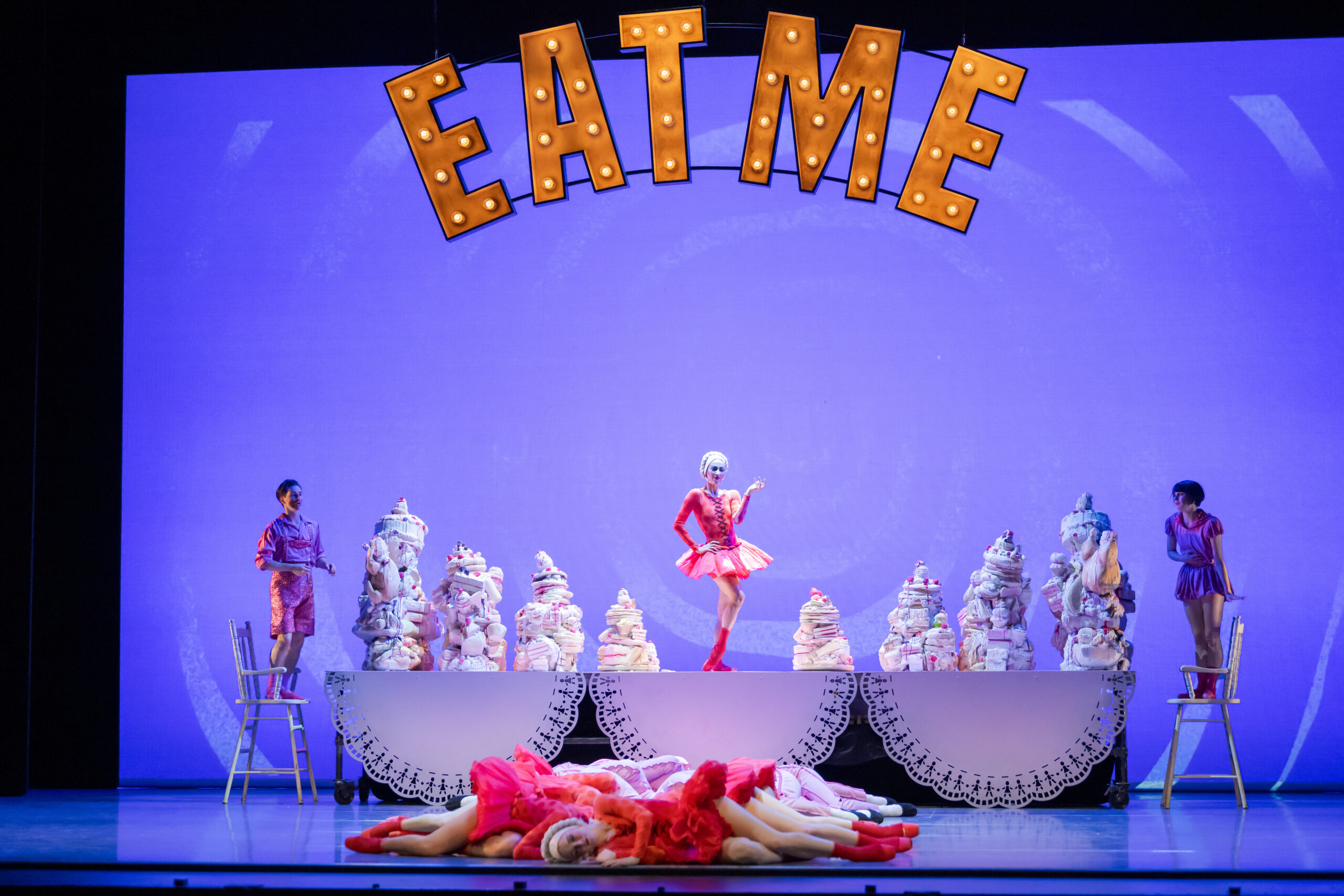
The Royal New Zealand Ballet’s Hansel & Gretel, 2023. Choreography, Loughlan Prior. Music, Claire Cowan. Design, Kate Hawley, Lighting, Jon Buswell. Photo credit: Stephen A’Court.
How do you want audiences to feel when they experience Macbeth?
I’d hope that they think it was the best money they’ve paid for a ticket in ages. I hope they follow the story and are taken on an emotional journey where they can really get stuck into what’s happening on stage.
How do you feel when the lights dim, and the performance begins on opening night?
I don’t know how many opening nights I’ve had over the 30 odd years I’ve been doing this. Of course, how you feel depends very much on the sort of production week you’ve had and whether the dancers, technicians, musicians have settled into the show. Sometimes it all slots together well and other times you are still working on things right up to the show starting. So opening night can feel anything from a warm confident enjoyment to a nerve-wracking rollercoaster ride hoping that things go well.
How do you stay motivated and inspired, even when projects are difficult or stressful?
I think all of us in theatre thrive on creating things on the fly and making concepts turn into reality. I have enjoyed over the years working with teams of people who all want the best possible outcome; stress and difficulty tend to be just part of the job to make good theatre. We certainly get a kick out of a room full of audience clapping and in general when we hear that, it justifies whatever we’ve been through to get the show on stage. Sometimes it’s punishing though and that’s hard, but we’re a fairly tight knit bunch of people who support each other.

If you weren’t a set and lighting designer, what career do you think you might have pursued?
No idea. I tend to like solving problems and I’m fairly practical, so any ideas are welcome.
How do you unwind or find inspiration outside of the theatre?
Just now I’m trying to get through a list of classic books. When I’m in a city I usually go to the art galleries for a mooch about. I listen to music. Normal stuff.
Is there a design you’ve always dreamed of creating but haven’t had the chance yet?
Not as such. I have projects that I’d like to tackle in the future (hence reading the classics). Generally, though, I am approached about doing something and if it feels right for me to do it, I jump right in.
What is the one piece of advice you’d give to aspiring designers?
Just to not be in a hurry to conquer the world. The best designers have all worked different jobs in theatre at the beginning of their careers. That pays dividends later when you design something and your crew ask how something should be done. If you have a reasonable background through doing all sorts of jobs, you are better placed to advise. If you have just produced a design with no idea how to make it work, you lose respect of your crew quite quickly.
Macbeth is touring nationally from 25th February to the 21st March 2025.