Q&A with scenic artist Tina Rae Carter
Tina Rae Carter - My Journey as a Scenic Artist
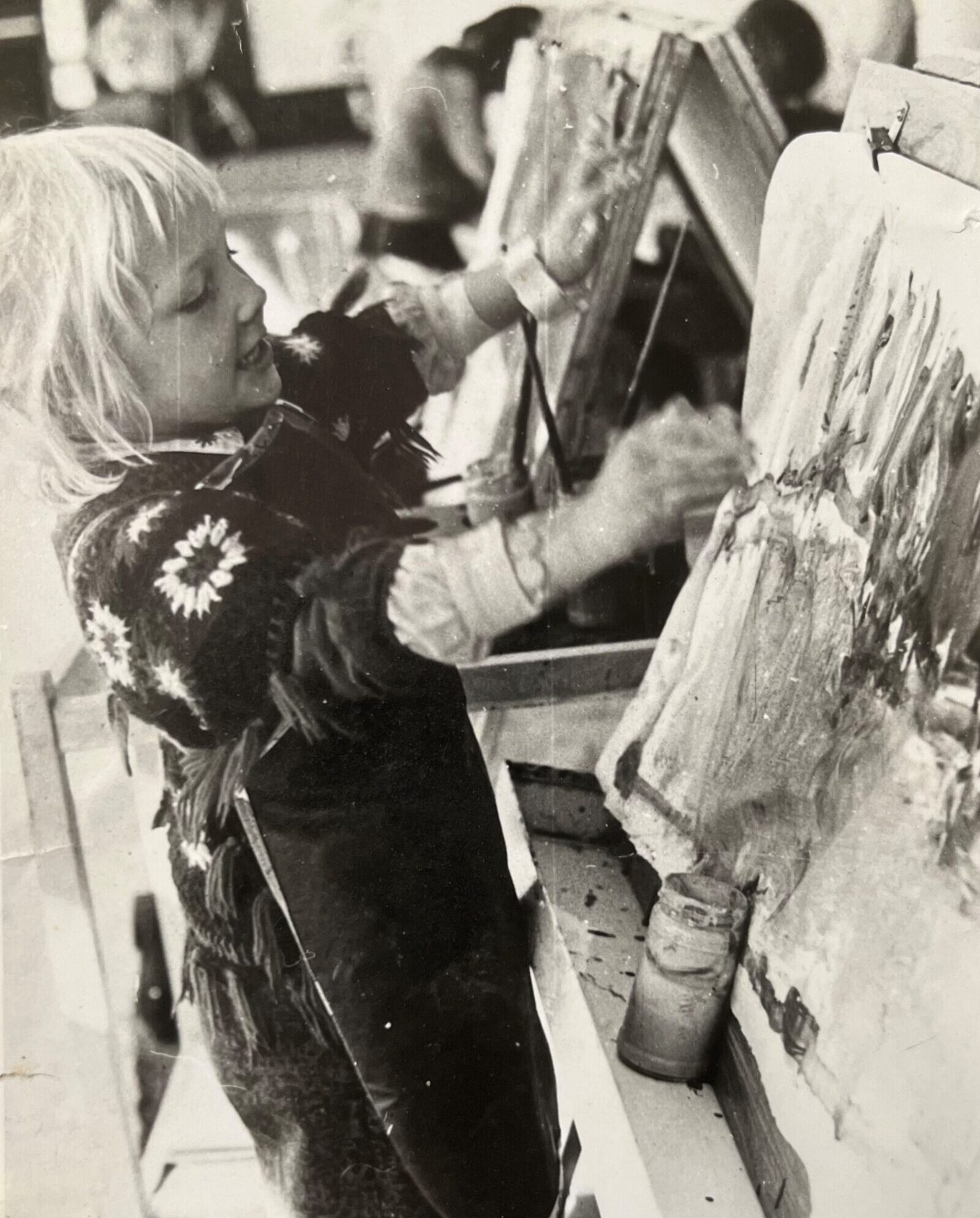
Tina creating one of her first artworks
An exploration of artistry, discovery and transformation behind the scenes
Tina Rae Carter is one of the creative forces working in the RNZB Production team. As a scenic artist, her craft is rooted in the traditional skills of hand-painting expansive backcloths and sculpting large-scale props, bringing stage designs to life.
Tina is currently realising Tracy Grant Lord’s extraordinary designs for our eagerly awaited new production of The Nutcracker. We sat down with Tina to learn more about her varied career, her creative process, and the work she is undertaking for The Nutcracker.
How did you train to become a scenic artist?
Like many artists, my fascination with creating imagined worlds began in childhood. I was the sort of child who would constantly add to an internal diary of visual images that delighted or evoked emotion from the shapes, or light play.
Born into a Wairarapa theatre family, I was on the stage before the age of three. It was a natural progression that found me in the theatre, from the age of 15, painting sets for the Masterton Theatre Company and my own college productions. After moving to the Manawatū, I continued painting and designing sets for local theatres.
I was hooked on the magic and wonderment of stagecraft. Seeing something you had made with cardboard, glue, and paint come to life, and be built. Or a white set of flats be transformed with just your paint application and clever lighting!
I studied at Whitecliffe School of Fine Arts and the University of New Mexico before moving to Melbourne, where I completed a Diploma in Visual Arts at R.M.I.T. and began paid scenic work.
On the job, I absorbed tricks from seasoned artists and designers, using everything from a single-haired brush to a roller or spray gun. I learned to study surfaces and imagine how to replicate them with the least paint. At the time, with CGI only emerging, there was strong demand for scenic work in film, television, murals and sculpture.
When did you first start working with the RNZB? Do you have an all-time favourite RNZB production you’ve worked on?
My first RNZB production, and my favourite, was Romeo and Juliet in 2017. The set was phenomenal! I was on props, but also undertook some scenic work, and that’s what I have been doing for the ballet ever since.
Another favourite was Cinderella, as the fab trio were on the job (Loughlan Prior, Claire Cowan and Emma Kingsbury). The ballet was most entertaining and the set delightful.
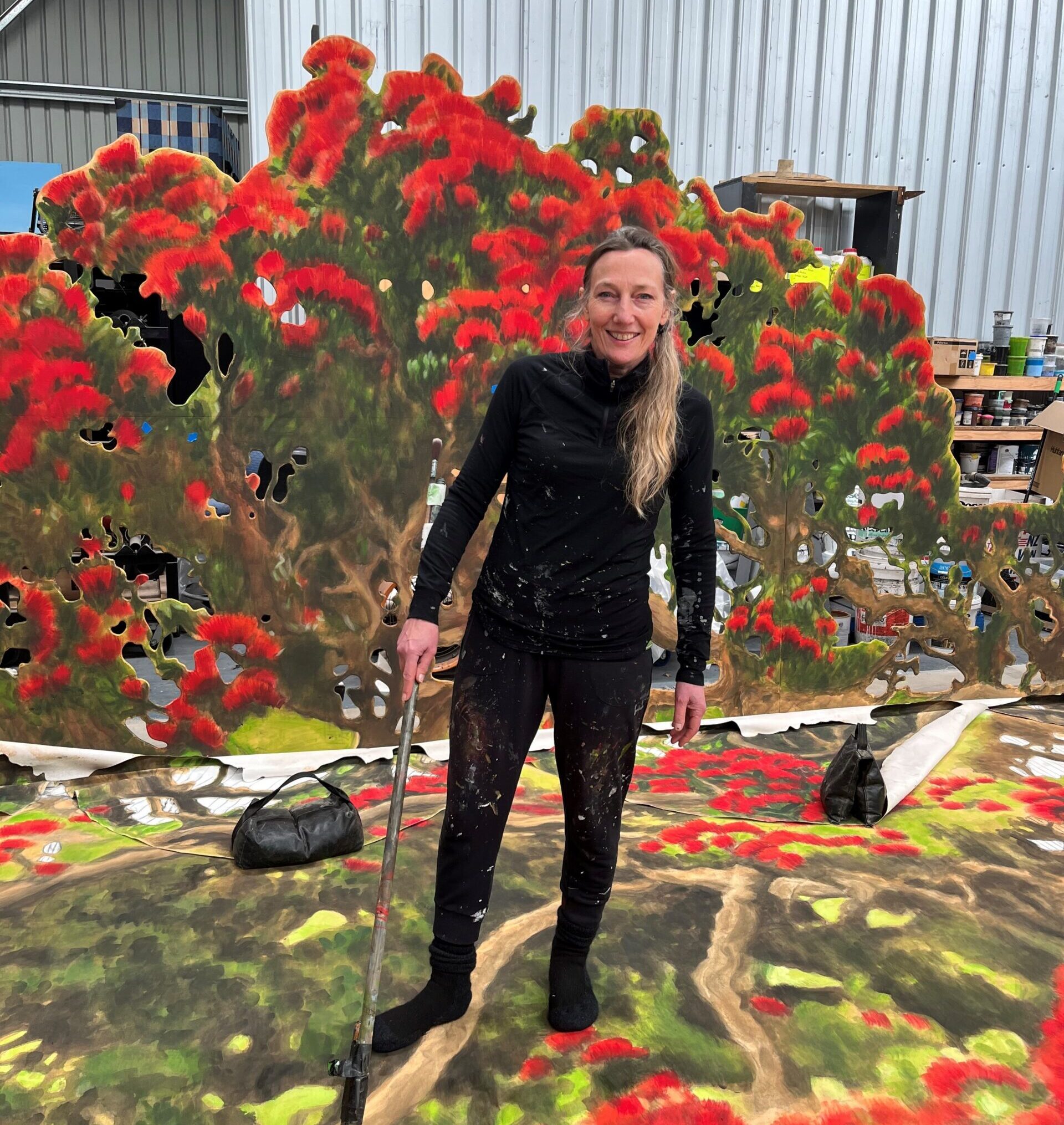
Tina creating the Pōhutukawa back cloth for The Nutcracker
Can you talk about your creative process when you are starting to work on a new production?
I speak with the designer to make sure the visual language will be translated correctly. Then there will be a lot of colour matching, mixing paints, tests and discussions with Gavin Underhill, RNZB Workshop Manager.
The project gets broken down into a logical sequence for the available time, with a specific tool and application method chosen for each aspect of the scenic work. These discussions happen very early on when the design is first approved by the Artistic Director to ensure we have all the materials we need.
What are you painting for the Nutcracker? What is the most challenging aspect of The Nutcracker?
This version of The Nutcracker has a lot of hand painted scenic back cloths. I am working on those mostly, with minimal paint effects employed on some other aspects of the set.
The most challenging part is the giant Pōhutukawa tree that grows overnight. It’s incredibly detailed and must appear seamless over different surfaces. The hours are plentiful and many hundreds of Pōhutukawa flowers need to be painted in!
Last year you worked on the restoration of Kristian Fredrikson’s designs for Swan Lake. What did this involve?
The back cloths for Swan Lake had aged over time and paint had worn off in the creases and folds from use and storage. The backcloths had been originally painted in Australia with an airbrush, so I had to colour match and airbrush any worn paint to renew the images.
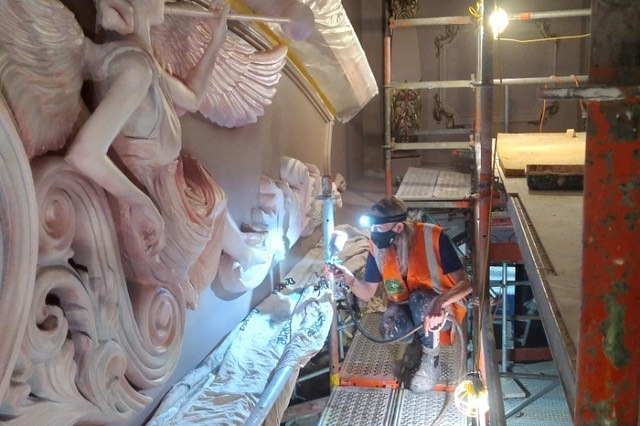
Tina working on reinstating the proscenium sculptures, from the original designs of the St James Theatre.
Can you tell us a bit about the historic restoration work you did on the St James Theatre.
This was a remarkable project to be part of. I worked closely with the architect and conservator to create a colour palette and approach that reflected early newspaper descriptions of the theatre’s 1912 interior. Once the design was finalised, I led a team to realise the artistic finishes, paint effects, new plasterwork and sculptural details, while coordinating with painters and construction crews on ever-changing scaffolds, all during Covid and while the RNZB prepared for another ballet.
The highlight was reinstating the proscenium sculptures, never completed in 1912. I designed these based on the original architect Henry Eli White’s intentions, then collaborated with plasterers to sculpt and cast the missing details. The project received a Dulux Colour Award.
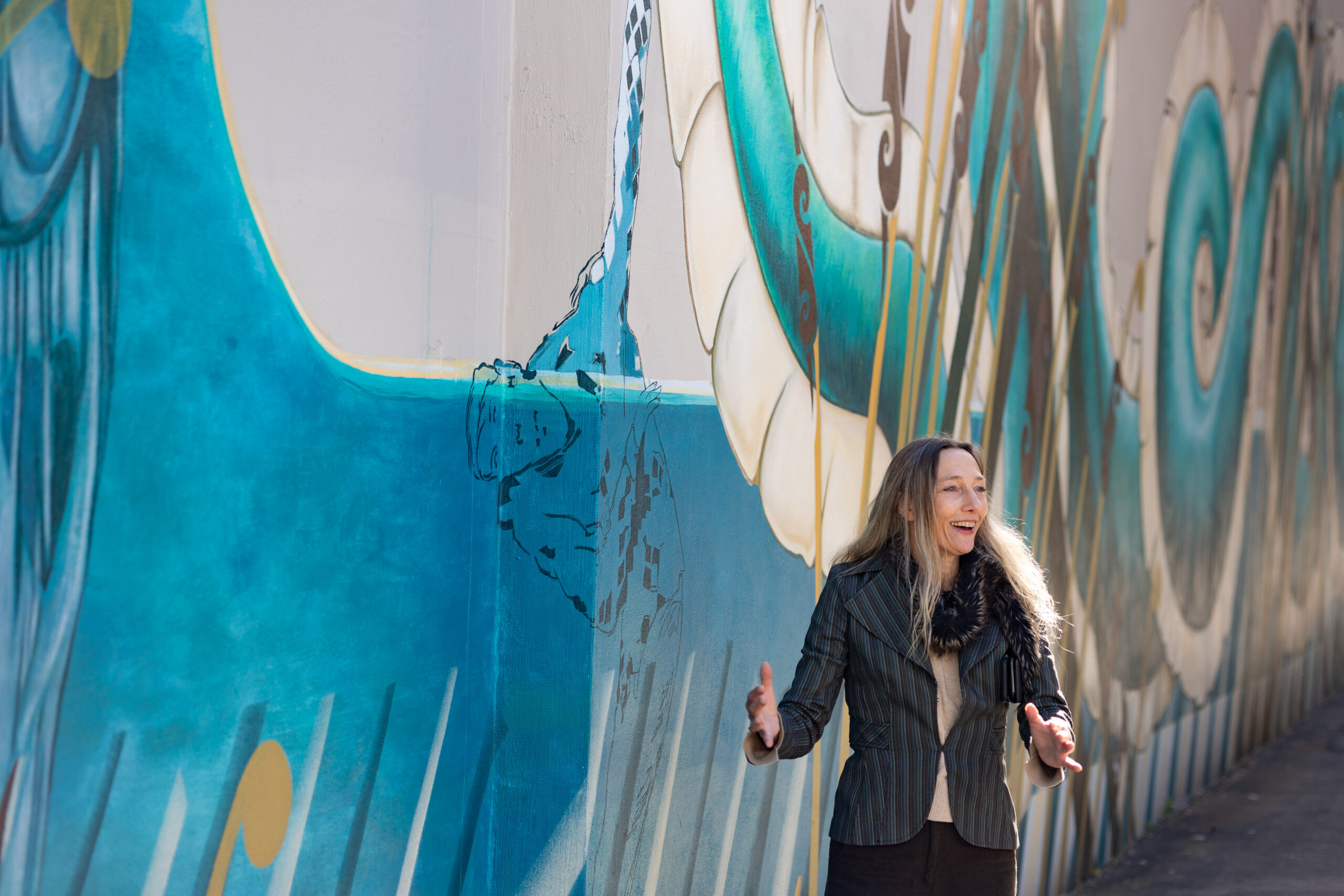
Tina at the unveiling of the St James Theatre Mural in 2023, by artists Keri-Mei Zagrobelna and Tina Rae Carter
You also created the epic 17-metre-tall mural on the side of the St James Theatre. How did that come about and can you tell us about the imagery.
The side of the St James Theatre was plagued with graffiti, and council had to do something to make the alley way feel safer, and less of a target for vandalism. They had engaged Mana Whenua artist Keri-Mei Zagrobelna to work on initial designs for a mural. This was her first project of this scale, and I was employed as a mentor, and co-designer of the mural.
For my part I spoke for the building and the ballet and Keri-Mei spoke for the land and the history of the Waimapihi stream. Inside the mural these elements are entwined. The large curtain at Courtenay Place holds embroidery designs from Cinderella’s bodice, morphing into korowai; the cherub and Taniwha speak to each other via pūroho; and the Taniwha is born from the mouth of the stream with the ballet dancers woven in as patupaiarehei of the forest.
What other work do you undertake outside of your work as a scenic artist for the RNZB? What’s next for you?
Aside from scenic artwork, I do design work and historical restoration and have been involved in festivals, creation of public murals, and workshops with youth. Next up will be the RNZB’s new production for the start of 2026!
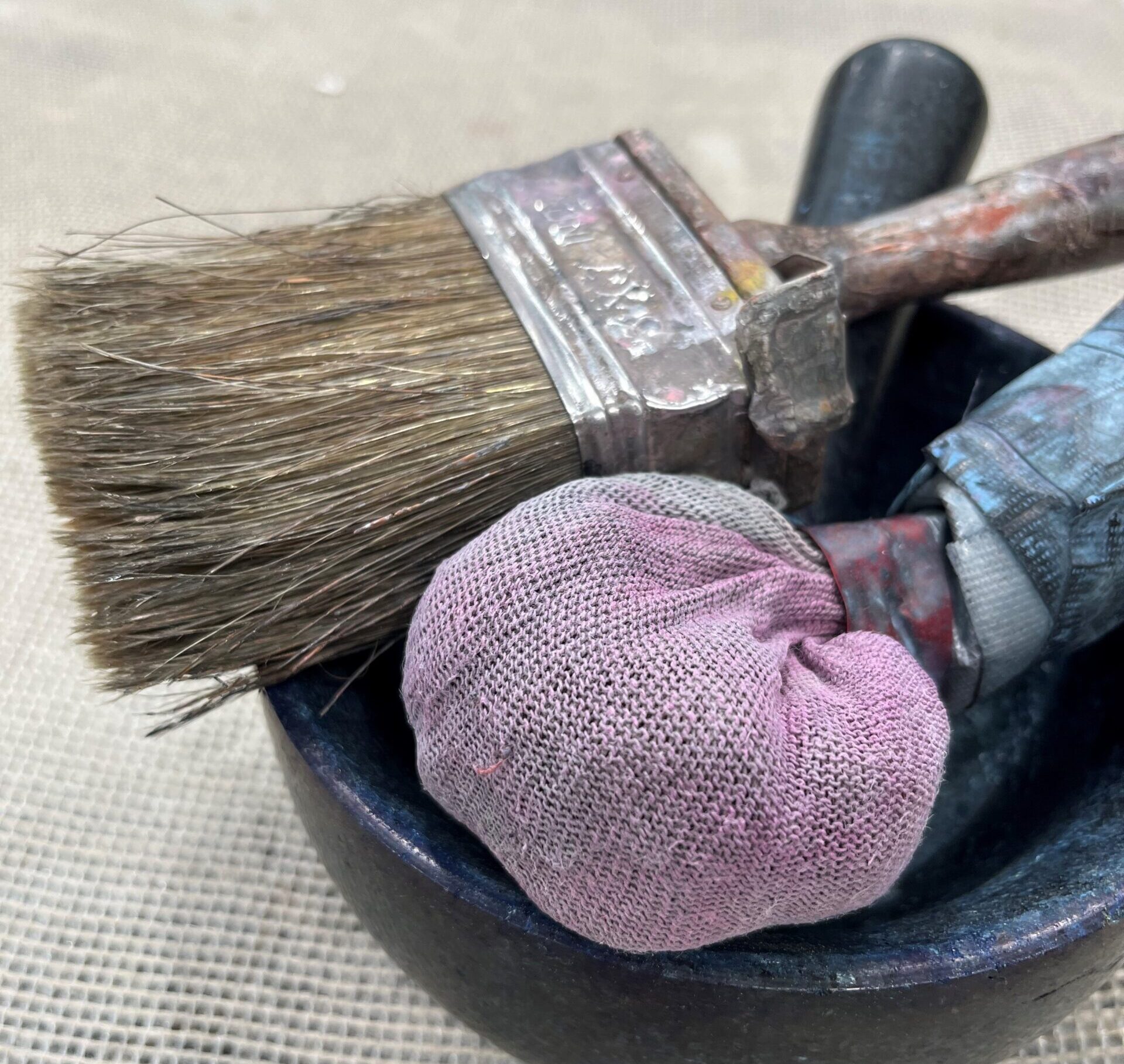
Tina’s current favourite tool, ‘Mr Blobby’
What’s the strangest or most unexpected material you’ve ever used in your work?
The materials are so varied that I no longer find them unexpected. When you use shellac and find out that that is made from beetles’ wings you must employ a certain cognitive dissonance!
What’s your go-to music when you’re working?
Anything that sets the scene. Currently it’s a mash up of old school musicals,1950s music, jazz and history podcasts. I have also been known to play the music from the ballet we are working on but will switch to something like Cowboy Junkies or Xavier Rudd for a bit of flavour, as too much of anything is not good.
If you could collaborate on a dream project anywhere in the world, what would it be?
Well, I’m living the dream, aren’t I? But, if I was to wake up tomorrow in the Gulf of Mexico or just off an African coast on a speed boat amidst the set of an epic and truly inspiring fantasy block buster that I had written, and done the production design for, that might well be heaven!
What’s the one tool you couldn’t live without?
There are many, but the current would have to be ‘Mr Blobby’ – a selection of torn up sponge that sits inside a muslin package on the end of a stick. He’s organic!